1. Overview of ash pneumatic conveying roots blower
In coal-fired power plants, roughly 80 % of combustion residue is fly ash, collected by electrostatic precipitators (ESP) or baghouses. Moving that ash from hopper to silo without water and without dust escape is where ash pneumatic conveying comes in. Instead of flushing ash with water or dragging it on belts, the system uses air as the carrier medium inside an enclosed pipeline — keeping ash dry (preserving pozzolanic value for cement / brick reuse) and the plant floor dust-free, this important machine is roots blower.
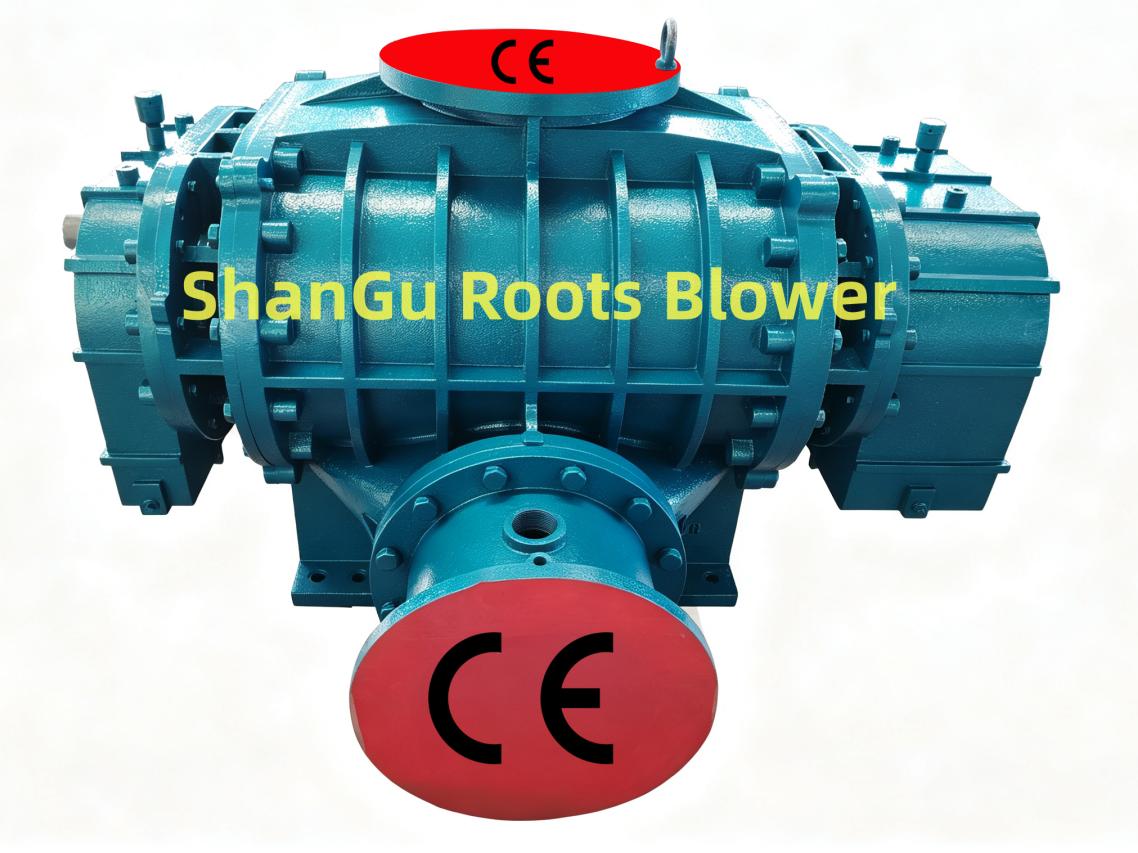
The air source at the heart of most utility-grade systems is a roots blower (positive pressure) or, on the suction side, a roots vacuum pump. Both belong to the positive displacement blower family, which matters for one reason: a PD blower delivers constant volumetric flow against changing back-pressure, so the line velocity doesn’t collapse when ash loading spikes — and that’s what keeps the pipe from plugging.
2. Process Flow (ESP → Silo) through Roots Blower
- Capture – Fly ash settles into ESP / hopper bottom outlets.
- Feeding – Ash is metered from the hopper into the convey line via a dome valve / rotary feeder / send tank.
- Conveying
- Positive side: A roots blower for pneumatic conveying (or, for longer runs, a compressed-air vessel pump) injects low-pressure high-volume air (typical 9.8–98 kPa / ~1–15 psig for dilute phase) to fluidise and push ash down the pipe.
- Negative (suction) side: A roots vacuum pump mounted at the line terminus pulls the pipe below atmospheric pressure; ash is inducted through suction nozzles and carried to a cyclone / separator.
- Separation & storage – At the silo roof, a cyclone + bag filter separates ash from air. Clean air vents; dry ash drops into the silo for loading or cement-plant dispatch.
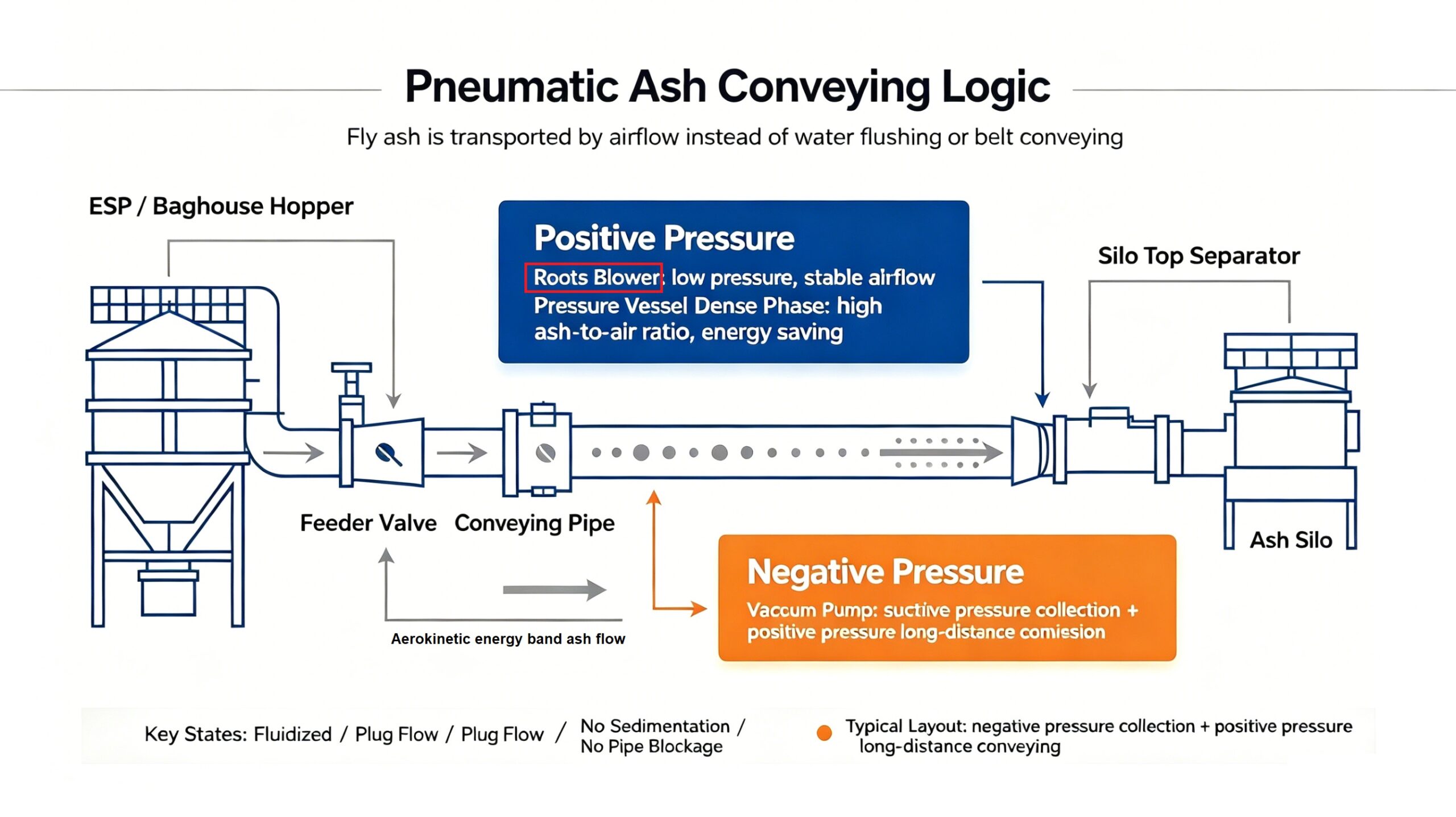
3. Positive vs Negative*(roots blower vs roots vacuum pump): Where Each Fits
| Positive (Roots Blower / PD Blower) | Negative (Roots Vacuum Pump) | |
|---|---|---|
| Drive | Forced air into the line (pressure) | Suction from line end (vacuum) |
| Typical kit | 3-lobe roots blower (dilute); dense-phase send tank + compressor for long hauls | Water-ring or roots-type vacuum pump; low-vac (<1000 mmH₂O) or high-vac |
| Best for | Long distance, high tonnage, main trunk (ESP → remote silo) | Multi-hoppers feeding one collection point; short, leak-sensitive pickups |
| Leak behaviour | Leak = dust out → sealing critical | Leak = air in → no dust escape (cleaner for indoor/captive points) |
| Ash–air ratio | Can run high, esp. dense-phase (30–50 kg ash / kg air) | Generally dilute, lower throughput |
Why PD blowers dominate here: Centrifugal fans lose flow as back-pressure climbs and can drop material out of suspension. A positive displacement blower holds flow constant — the single biggest anti-plug feature in ash lines.
4. Dilute Phase vs Dense Phase (the “roots blower” split)
- Dilute phase (roots blower territory) — 15–35 m/s (≈ 3000–7000 FPM), 1–15 psig. Ash fully suspended in air. Cheaper upfront, good for shorter runs, but higher wear + higher air volume.
- Dense phase (vessel / compressor, sometimes still called “roots blower pneumatic conveying” in loose trade talk) — 3–8 m/s, 15–30 psig, ash moves as plugs/slugs. Lower velocity = far less elbow wear, lower air consumption, but needs a send tank and tighter control.
Most 300–600 MW units today run negative suction for hopper collection → positive dense-phase for the trunk (“front-negative, back-positive”).
5. Sizing & Anti-Plug Checks (what buyers ask)
- Minimum conveying velocity — keep ≥ ~18 m/s (3500 FPM) in dilute; drop below and ash settles.
- Ash temperature — ESP outlet ash is 130–180 °C; blower选型 (three-lobe, heat-treated rotors) must tolerate.
- Abrasion — fly ash is glassy and hard. Elbows get lined (ceramic, SiC, cast basalt); rotor surfaces on the PD blower often hard-chrome or tungsten-carbide coated when ash carry-back happens.
- Ash–air ratio (μ) — pushing μ up saves air and pipe diameter, but too high → plug risk + pressure exceeds blower / vacuum-pump envelope. PD blowers for ash duty typically sized with a safety margin on both pressure and temp rise (max ~121 °C / 250 °F continuous).
6. Typical “Combo” Layout in a 2×300 MW Plant
ESP Hopper A/B/C ──(negative, roots vacuum pump)→Intermediate surge hopper
↓
Dense-phase send tank
│
(positive displacement compressor/roots blower)
↓
Fly-ash silo (cyclone + bag filter)
↓
Bulk truck / cement plant
7. Keyword Clarification (buyer-facing)
You’ll see procurement specs use “roots blower vacuum pump” interchangeably. Technically:
- Roots blower = positive displacement, pressure duty (ash push)
- Roots vacuum pump = same lobe principle, suction duty (ash pull)
- Both are positive displacement blowers; the “roots blower vacuum pump” phrasing is a buyer-search artefact — we support both duties, often from the same frame/bearing platform, bi-rotational on some models.
FAQ:
Q1: What is the role of a roots blower in ash pneumatic conveying?
A roots blower (a type of positive displacement blower) supplies low-pressure, constant-volume air to fluidise and push fly ash through the pipeline—typically on the pressure leg from an intermediate hopper or send tank to the silo. Its PD characteristic keeps conveying velocity stable even as back-pressure fluctuates, which is the key to avoiding plug-ups in ash lines.
Q2: Can a roots vacuum pump be used instead of a roots blower for fly ash?
Not exactly “instead”—they serve different legs. A roots vacuum pump runs on the suction side, pulling ash from multiple ESP hoppers into a collection point. It’s ideal for short, multi-drop pickups because any leak draws air in, not dust out. Most plants run negative (roots vacuum pump) for hopper collection + positive (roots blower) for the long trunk—the classic “front-negative, back-positive” layout.
Q3: Dilute phase or dense phase—which should I choose for fly ash?
- Dilute phase (15–35 m/s, ~9.8–98 kPa): Uses a roots blower directly; cheaper upfront, simpler control, but higher air volume and faster elbow wear.
- Dense phase (3–8 m/s, plug/slug flow): Needs a send tank + higher-pressure air source; far less abrasion, lower power per ton, preferred for >300 m runs or high-TPH units.
Rule of thumb: if your run is <200 m and budget-tight, dilute + PD blower; if >500 m or ash is abrasive, dense phase wins.
Q4: Why specify a positive displacement blower instead of a centrifugal fan for ash duty?
Centrifugal fans lose flow as back-pressure rises—exactly when ash loading spikes and you need flow most. A positive displacement blower holds near-constant CFM regardless of line pressure, so minimum conveying velocity (~18 m/s) stays above the saltation point. In fly-ash service, that’s the difference between a running line and a plugged elbow at 2 AM.
Q5: How do I size a roots blower for an ash pneumatic conveying system?
Three numbers get you 80 % there:
- Distance & elevation (static + friction loss → required discharge pressure)
- Ash TPH & target ash–air ratio (μ) → required CFM
- Ash temperature at pickup (ESP ash is 130–180 °C) → rotor clearance & cooling spec
Add a 15–20 % margin on both pressure and temp rise, and you’re safe. If you’ve got the data, send it over—we’ll size the PD blower and silencer to match.
Q6: What wears out first in a fly-ash roots blower system?
Elbows and the roots blower‘s sync gears / rotor coating, in that order. Ash is glassy and hard—line elbows usually get ceramic or SiC liners; blower rotors for ash duty are often hard-chrome or tungsten-carbide coated if there’s any carry-back. The blower itself lasts 5–8 years easy if inlet filtration is right; elbows are the consumable.