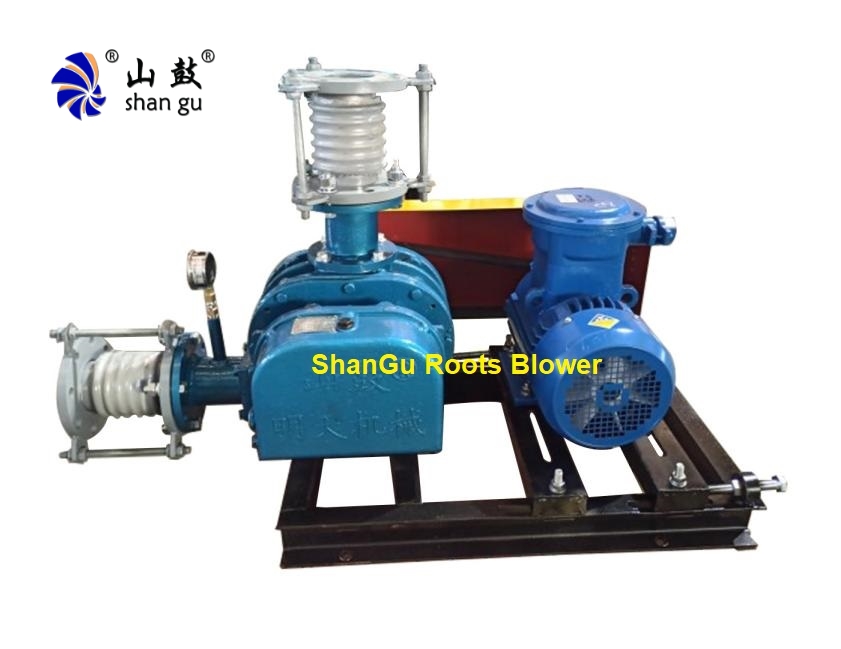
A próiseas séidire fréamhacha gáis is a positive-displacement rotary lobe blower engineered for hazardous process gases instead of clean air. Úsáideann sé dhá rótar frith-rothlach sioncronaithe chun gás a ghabháil i méid an rótair-chásála, é a iompar ó inlet go asraon, agus sreabhadh cobhsaí a sheachadadh i gcoinne backpressure píblíne. Le haghaidh bithgháis, hidrigin, VOC, gás líonadh talún, gás géar, CO₂ and metallurgical gas, it can be upgraded with stainless wetted parts, rónta meicniúla dúbailte, nitrogen barrier sealing, and explosion-proof motors to reduce leakage, corrosion, ignition and oil-contamination risks.
Quick takeaways
Stable volumetric flow controlled mainly by speed; pressure follows downstream backpressure.
Wetted parts in 304 / 316L / 2205 duplex for acidic, moist or sulfur-bearing gas.
Double mechanical seal plus nitrogen barrier for toxic/flammable service; oil chamber isolated from gas path.
Explosion-proof motor and Ex/ATEX/IECEx-compatible panel options for hazardous zones.
Typical inquiry applications: biogas upgrading, landfill gas recovery, hydrogen purge/boosting, VOC tail gas, desulfurization/odor gas, metallurgical gas transfer.
How a Process Gas Roots Blower Works
A próiseas séidire fréamhacha gáis moves gas by volume, not by internal compression in every case. Two rotors turn in opposite directions with timing gears, capture gas in the cavity between rotors and casing, and transfer it toward the discharge port. Because rotor-to-rotor and rotor-to-casing clearance is small and non-contact, the machine can run continuously with low pulsation when properly sized.
Positive Displacement Principle for Process Gas
Gas enters the inlet, is trapped in the lobe cavity, rotates with the rotor, and is released at the outlet. Flow rate is primarily determined by rotor size and speed; discharge pressure is set by the connected pipeline, scrubber, flare, compressor inlet or engine manifold. This makes the roots design suitable for constant-flow duties where the process needs predictable m³/h rather than variable flow under changing pressure.
Why Flow Remains Stable Under Backpressure
Because each revolution displaces a fixed gas volume, a roots blower maintains flow closely with speed. If filter pressure drop, scrubber resistance or pipeline backpressure changes within the design range, the delivered volume stays relatively stable while power and temperature adjust. For variable demand, add VFD control and re-verify rotor clearance, seal differential and motor rating.
Corrosion-Resistant Materials for Hazardous Process Gas
Corrosive process gas destroys standard cast-iron blowers through pitting, acid attack and moisture-induced corrosion. A corrosion-resistant process gas roots blower selects wetted materials by gas composition, H₂S level, chlorine/ammonia presence, humidity and operating temperature.
304, 316L and 2205 Duplex Stainless Options
304 cruach dhosmálta: mild corrosive service, clean or low-chloride process gas.
316L cruach dhosmálta: biogas with H₂S and moisture, VOC condensate, weak acid/alkali streams. 316L is commonly specified for biogas rotors and internals because H₂S plus water forms acidic conditions that attack carbon steel/cast iron .
2205 duplex stainless: higher chloride, abrasive moisture, sour service requiring strength plus pitting resistance.
Cásáil, rótar, timing-gear chamber parts, fasteners and inlet/outlet flanges can be upgraded as a complete wetted-path package.
Coatings and Linings for Acidic, Sulfur-Bearing Gas
For high H₂S, flue-gas desulfurization air, odor-control exhaust or chloride-containing VOC, use epoxy, PTFE-based or fluoropolymer coatings on selected non-stainless parts. Coatings reduce pitting and make cleaning easier, but the base metal must still match the gas severity. Never specify coating alone for deep sulfur/chloride service without rotor-material review.
Sealing Systems for Toxic and Flammable Gas
Leakage control is the core safety difference between an air roots blower and a process gas roots blower. The right seal depends on toxicity, inadhainteacht, difreálach brú, abrasive particles and whether the gas can contact bearing lubricant.
Double Mechanical Seal for Process Gas Roots Blower
A double mechanical seal uses two seal faces with a buffer or barrier fluid chamber between them. For toxic/flammable media, this gives redundant isolation: if the process-side face wears, the barrier side still blocks outward leakage. Select seal faces, elastomers and springs by gas chemistry—hydrogen needs low-leakage face combinations; sour gas needs H₂S-resistant elastomers; VOC with solvent condensate needs chemical-compatible O-rings.
Nitrogen Barrier and Purge System Integration
Add a nitrogen barrier system to the double seal for methane, hidrigin, syngas, VOC or H₂S gas. Nitrogen at controlled pressure enters the seal buffer chamber, creates positive isolation toward the process gas and atmosphere, and carries minor leak trace to a safe collection point. Sochair:
Prevents toxic/flammable gas migration to bearing housing.
Reduces air ingress for inert/toxic streams.
Keeps lubricant out of the process gas path.
Supports ATEX/IECEx documentation by removing ignition and contamination pathways.
Oil-free roots designs further isolate the lubrication chamber from the gas chamber so discharged gas is not contaminated by gear/bearing oil .
Explosion-Proof and Safety Design
A process gas roots blower for combustible gas must remove ignition sources and control surface temperature. This includes motor, starter, sensors, heater bands, lighting near the package and any VFD in the hazardous area.
ATEX, IECEx and Class I/Zone Requirements
Specify regional compliance by project location:
Europe: ATEX 2014/34/EU, Zone 1/Zone 2, gas groups and T-class by media.
International projects: IECEx equivalent certification.
North America: Class I, Division 1/2 or Zone system per site standard.
Bithghás, gás líonadh talún, hidrigin, gasoline VOC and coke-oven/smelter gas usually require explosion-proof motor and Ex-rated junction box; flashback/arrestor, pressure relief and gas-detection interlocks are added per process safety review .
Explosion-Proof Motor and Control Matching
Select motor Ex protection type by zone and gas group, not by blower model alone. For hydrogen, use hydrogen-specific group and T-rating; for methane-rich biogas, use methane-group rating with proper surface-temperature limit. Pair with VFD if flow modulation is required, but validate VFD harmonics, motor temperature rise and seal barrier supply under low-speed operation.
Cooling, Temperature Control and Continuous Duty
Process gas temperature rises across the blower from compression, slip and inlet heat. Uncontrolled casing temperature can damage seals, elastomers and electronics.
Air-Cooled vs Water-Cooled Process Gas Roots Blower
Air-cooled: small/medium packages, moderate inlet temperature, easy site installation. Add fan, cooling jacket or enlarged casing for high-temperature gas.
Water-cooled: high inlet temperature, continuous biogas/chemical duty, tight seal-temperature limits, tropical sites. Use closed-loop jacket water or plant cooling water with corrosion-resistant circuit.
Set alarm/trip on bearing temperature, seal barrier pressure, casing temperature and outlet temperature. Le haghaidh bithgháis, keep discharge temperature below the project safety limit because methane/air mixtures and H₂S acid formation become more aggressive as temperature rises .
Applications by Gas Type
Use the table below as a first screening guide; final material/seal/ex certification depends on full gas analysis.
| Gás / iarratas | Main risks | Recommended upgrades |
|---|---|---|
| Bithghás / digester gas | CH₄ flammable, CO₂+H₂O acidic, H₂S corrosive | 316L rotors/casing, double mechanical seal, nitrogen barrier, ATEX motor |
| Landfill gas | Variable methane, siloxanes, taise, H₂S | Stainless wetted parts, inlet filtration, dual seal, purge, explosion-proof package |
| Hidrigin / purge gas | Very low ignition energy, leakage | Low-leak double seal, H₂-rated Ex motor, tight clearance check, nitrogen barrier |
| VOC / chemical tail gas | Solvent condensate, toxic, pléascach | chemical-compatible seals, 316L/2205, ATEX/IECEx, solvent-resistant coatings |
| Sour / desulfurization gas | H₂S+moisture acid, toxic | 316L or duplex, H₂S-rated elastomers, dual seal, barrier gas, temperature control |
| Odor / biofilter feed | H₂S, mercaptans, ammonia | corrosion-resistant casing, mist removal, mechanical seal, low pulsed flow |
| Metallurgical / gás cóic-oigheann | tar mist, CO, cáithníní | filtered inlet, hardened/stainless rotors, seal purging, explosion-proof motor |
| CO₂ / inert recycle | Dry/wet corrosion, purity | stainless or coated path, oil-free seal isolation, dew-point review |
Process Gas Roots Blower for Biogas and Landfill Gas
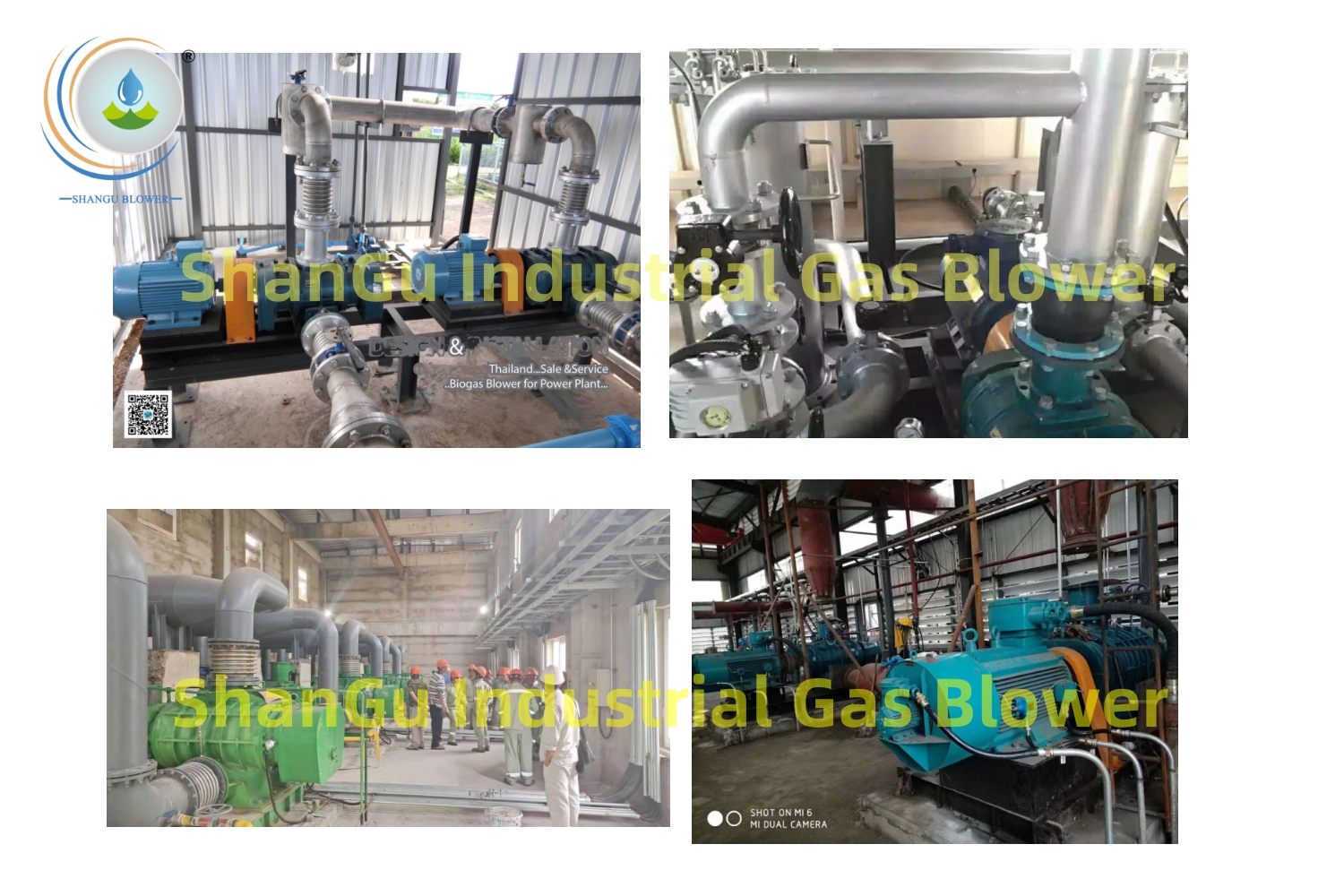
Biogas roots packages move digester or landfill gas to upgrade skids, CHP engines, boilers or flares. Raw biogas commonly contains methane, CO₂, water vapor and H₂S; standard air blowers fail from acid corrosion and ignition risk. Specify stainless rotors, explosion-proof motor, gas-tight seals and inlet separation for condensate and siloxanes .
Hydrogen and VOC Process Gas Conveying
Hydrogen needs smallest leak path and H₂-compatible Ex rating; VOC streams need solvent-compatible elastomers and barrier gas to avoid cross-contamination. For low-pressure recovery, roots blowers give stable volume flow; for high-pressure compression above the roots economic range, pair with screw/reciprocating booster after process review.
Ceimiceach, Desulfurization and Odor-Control Duty
In chemical circulation, FGD oxidation air, H₂S odor extraction and biofilter feed, the blower must resist condensate and trace acid. Double mechanical seal with nitrogen barrier prevents odor/toxic leakage to the workshop; stainless or coated casing extends service interval.
Treoir Roghnúcháin: How to Size a Process Gas Roots Blower
Request a quote with the following data so engineers return a safe model instead of a generic air blower.
Required Inquiry Data for Accurate Quote
- Gas name and full composition (vol%), including CH₄, H₂, CO₂, H₂S, O₂, N₂, VOC species, Cl₂, NH₃.
- Inlet flow required in m³/h or cfm at actual conditions.
- Inlet pressure, required outlet pressure/differential, and total pipeline+equipment backpressure. 4. Inlet/outlet temperature, ambient temperature, airde.
- Moisture/saturation, deannach, tar, siloxane, solvent condensate.
- Hazardous zone classification: ATEX/IECEx/Class I, Zone/Division, gas group, T-class.
- Material requirement: 304/316L/2205, coating, exotic alloy.
- Cineál róin: single mechanical, double mechanical, nitrogen barrier, dry gas seal.
- Cooling: air-cooled/water-cooled; utility water quality if water-cooled.
- Mótar: voltas, Hz, IP, Ex type, VFD or fixed speed.
- Trealamh le sruth: scrubber, flare, CHP, membrane, comhbhrúiteoir, pipeline.
- Caighdeáin: API/ISO/ATEX/IECEx/UL, paint, NDE, test run, spare parts list.
Roots Blower vs Compressor for Process Gas
For low-to-moderate differential pressure with constant volume, a roots blower is simpler, oil-free-capable and easy to maintain. For high pressure or variable pressure with internal compression, screw/centrifugal/reciprocating machines may be more efficient. Many plants use a próiseas séidire fréamhacha gáis as low-pressure booster and a separate compressor for final high-pressure stage.
Maintenance and Reliability for Continuous Plants
A process gas roots blower has few moving parts, but hazardous gas service demands disciplined inspection.
- Check rotor/casing clearance periodically; corrosive pitting changes internal slip.
- Monitor double-seal barrier pressure and nitrogen consumption; any drop indicates face wear or supply issue.
- Inspect timing-gear backlash and bearing temperature; vibration rise often follows gear/bearing faults.
- Drain condensate from inlet silencer/manifold for biogas and landfill gas.
- Replace elastomers by H₂S/solvent exposure calendar, not only by runtime.
- Keep inlet filter matched to dust/tar/siloxane load; contaminated inlet increases rotor wear and seal failure .
CC: Process Gas Roots Blower
What is a process gas roots blower?
A process gas roots blower is a positive-displacement rotary lobe blower modified for hazardous gases. It uses two synchronized rotors to transfer a fixed volume per revolution and can include stainless wetted parts, rónta meicniúla dúbailte, nitrogen barrier, cooling and explosion-proof motor packages.
Can a roots blower handle biogas with H₂S?
Tá, if specified for biogas duty. Typical upgrades include 316L stainless rotors/casing, corrosion-resistant timing gears, rónta meicniúla dúbailte, condensate separation and ATEX/explosion-proof motor. H₂S concentration, moisture and runtime determine final material grade .
Is a process gas roots blower oil-free?
The gas path can be oil-free when the design isolates gear/bearing lubrication from the process chamber and uses mechanical seals or non-lubricated sealing. This prevents oil carryover into biogas, hidrigin, VOC and catalyst-protection streams.
Which seal is best for toxic flammable gas?
Double mechanical seal with nitrogen barrier is preferred for methane, hidrigin, H₂S, VOC and mixed toxic/flammable gas. It provides two isolation barriers and a safe purge path, reducing atmospheric leakage and lubricant contamination.
What pressure can a process gas roots blower deliver?
Roots blowers are mainly low-to-moderate differential-pressure machines; exact maximum depends on rotor size, luas, seal differential, temperature and gas density. Share required inlet/outlet pressure and flow so the supplier confirms single-stage or multi-stage and whether a compressor is better.
Do you provide ATEX and IECEx packages?
Tá, for hazardous zones. Scope includes Ex motor, Ex junction box/control, certified seals where applicable, temperature-class verification and project documentation. North American projects can be quoted to Class I/Division or Zone system per buyer specification.
Get a Process Gas Roots Blower Quotation
Send your gas composition, sreabhadh, inlet/outlet pressure, teocht, H₂S/moisture data and hazard zone. Our engineering team returns model selection, material spec, seal plan, cooling option, Ex certification list and spare-parts recommendation for biogas, gás líonadh talún, hidrigin, VOC, gás géar, CO₂ and metallurgical gas duty.
Inquiry form fields to include on the page
Gas name & composition | Flow m³/h | Inlet pressure | Outlet pressure | Inlet temp | H₂S/MOISTURE | Dust/tar/VOC | Zone/ATEX/IECEx | Material 304/316L/2205 | Cineál róin | Cooling | Motor EX rating | Target delivery date
Contact us with these data points to receive a sized próiseas séidire fréamhacha gáis proposal and RMS/lead-time quotation.