As Silo Vergassing Wortels Blaser: Die sleutel tot verstop-vrye afskeiding van vliegas
Steenkoolkragsentrales genereer elke dag groot hoeveelhede vliegas. Die tipiese ketting-elektrostatiese neerslaghouer → Wortelsblaser→ pneumatiese vervoer → as-silo-opberging → grootmaat vragmotorlaai – breek gewoonlik nie tydens die vervoerstadium nie, maar by die heel laaste oomblik van silo-ontlading. Onder langtermyn gravitasieverdigting, vliegas verhard, “brûe,” en boë. Die afvoerklep bly draai, maar geen as kom uit nie.
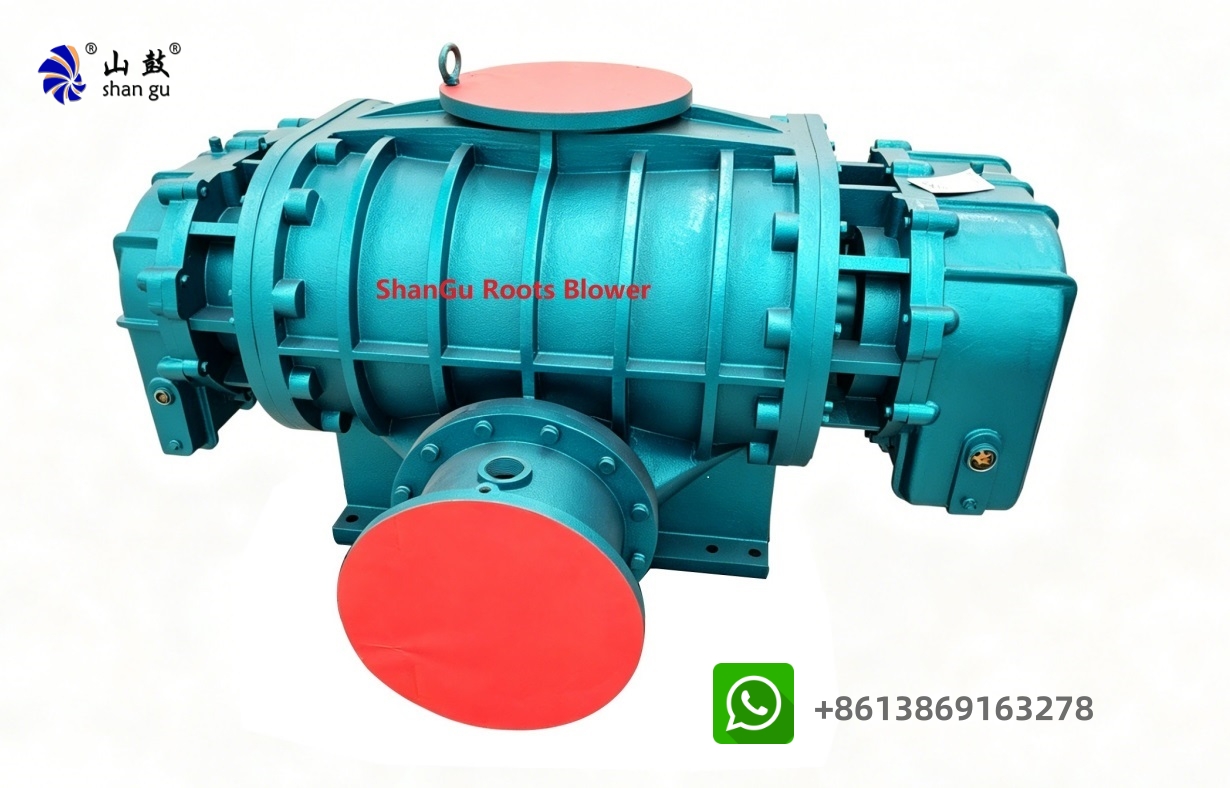
In ons vorige bespreking oor assilo / hopper vergassing (fluïdisering), ons het die basiese beginsel gedek: druk verhit, gedroogde saamgeperste lug in die vloeibak sodat die aslaag bo die poreuse plaat gefluïdiseer word en na die uitlaat gly. Binne hierdie ketting, die toerusting wat “druk die lug in” word byna universeel gespesifiseer as 'n wortelblaser.
Hierdie artikel verduidelik die beginsel end-tot-end, verduidelik die rol van die as silo vergassing wortels blaser, verskaf 'n prosesvloeidiagram met die blaser ingesluit, en bied praktiese keuse en diens Wortelsblaserleiding vir aanlegoperateurs en verkrygingspanne.
Vinnige opsomming: Wat die assilo-vergassingstelsel doen
Aan die onderste kegel van die assilo (of ESP hopper), vloeibare bakkeis radiaal gerangskik. Die trog-oppervlak is a fluïdiseringsplaat, (tipies silikon-karbied gesinterde poreuse plaat). Tydens operasie:
- A Wortelsblaserdruk omringende lug en lewer dit stroomaf af
- An elektriese verwarmerverhoog en droog die lug (tipies 80-150°C / 176–302°F)
- Warm lug sypel eenvormig deur die mikroporieë van die fluïdiseringsplaat, die vorming van 'n lugfilm tussen asdeeltjies
- Die vliegas skuif van statiese hoop na vloeistofagtige gefluïdiseerde toestand; die rushoek daal skerp, en as gly langs die 6°–15° troghelling na die afvoeruitlaat
In platbodem silo's, fluïdiseringskrippe word gewoonlik gerangskik radiaal, bedekking ≥15% van die silobasisoppervlakte, met 'n spesifieke lugverbruik van ongeveer 0.62 Nm³/(m2·min).
Binne hierdie stelsel, die blaser is nie die “ster”- maar as die blaser verkeerd gekies is, verhitting en fluïdisering misluk albei.
Hoekom 'n PD-blaser (Wortelblaser) Is die industriestandaard
In assilovergassing, die pd waaier, (Positiewe verplasingsblaser) word byna by verstek gespesifiseer. Om 'n worteleenheid met 'n sentrifugale waaier te vergelyk, maak die rede duidelik:
| Vergelyking | Wortelblaser | Sentrifugale waaier |
|---|---|---|
| Vloei kenmerk | Konstante vloei, minimaal beïnvloed deur terugdrukskommeling | Oplewing-geneig naby die piek van kromme |
| Drukreeks | Enkeltrap 9,8–98 kPa, dek 8–15 kPa vergassingsbehoefte | Laedruk tipe gewoonlik <10 kPa; ondoeltreffend as dieper |
| Stofverdraagsaamheid | Verdra effense terugvloei van as, robuust | Impeller dra-sensitief |
| Onderhoud | Eenvoudige struktuur, min slytasie dele, in-huis diensbaar | Streng dinamiese balans vereis |
| Geraas | 3-lob ontwerp + knaldemper aanvaarbaar | Stiller maar hoër kostevlak |
Die terugdruk van 'n vergassingstelsel = vloeibare plaat weerstand + asbedweerstand + pypleiding verlies, slegs totaal 3–8 kPa, maar vereis stabiele vloei, geen oplewing nie, en 24/7 deurlopende werking—presies waar die “harde karakter” van 'n wortelblaser pas.
Drie spesifieke rolle van die wortelblaser in die stelsel
① Stabiele lugtoevoer om die fluïdiseringsfilm te ondersteun
Die fluïdiseringsplaatmikroporieë is slegs tientalle mikron breed. Hulle maak staat op die laagdruk, hoë-volume lug uit die wortels blaser kompressoraan “borrel” eweredig. Onvoldoende vloei → film misluk → dooie assones; oortollige vloei → stof meevoer → oorlaai die sakhuis hierbo. Die konstante-vloei-aard van die wortelmasjien skyn hier.
(Let wel: 'n Wortelblaser is tegnies 'n positiewe verplasing kompressorwerk in die laedrukreeks. In die industrie word dit beide a genoem “Wortelsblaser” en a “wortels blaser kompressor.”)
② Werk saam met die verwarmer om droë warm lug na die keël te lewer
Die lug vanaf die worteluitlaat is in wese by omgewingstemperatuur, gaan dan die elektriese verwarmer binne om 80–150°C te bereik voordat dit die silo binnegaan. Sleutelpunt: die lug wat deur die wortelblaser gelewer word, is inherent droog, (geen verkoeling/ontvochtigingstadium vooraf nie); die verwarmer verhoog net temperatuur, nie herontvochtig nie—moenie dit met a verwar nie “afkoel-dan-herverhit” opstel.
③ Een-diens-een-bystand / drie-lopies-een-bystand vir kontinuïteit
N tipiese konfigurasie vir 3 as silo's (2 grof + 1 fyn) gebruike 4 wortelblasers + 4 verwarmers, drie hardloop en een bystand. As enige eenheid misluk, die bystand neem oor. Gevorderde opstellings parallel plant instrument lug + ontvanger tenkby die worteluitlaat as noodsteun - wanneer worteldruk onder die drempel daal, die stelsel skakel outomaties oor na rugsteunlug sodat fluïdisering nooit ophou nie.
Prosesvloeidiagram met assilo-vergassingwortelblaser (Standaard)
Dit is die mees algemene konfigurasie vir 300 MW / 600 MW-eenhede in China; dit kan direk vir P gebruik word&ID tekening:
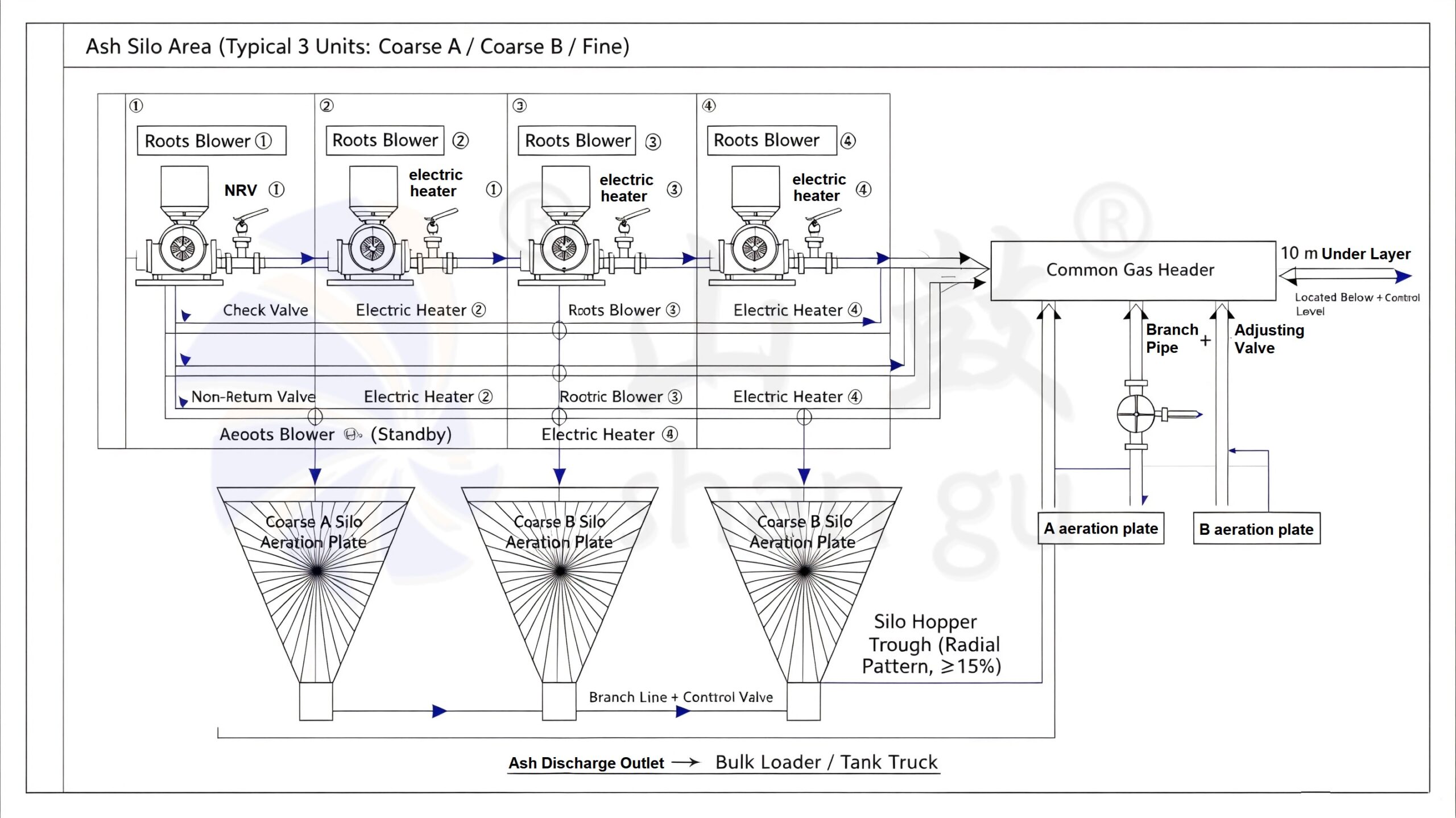
Node verduideliking:
Wortelblaser: vloei per silo afsonderlik groot; klein/medium silo 5–15 m³/min, groot silo >1000 m³ gebruik 15–30 m³/min, druk 8–15 kPa met 10%–15% marge
Terugslagklep: verhoed dat hoë-temp lug van verwarmer terugvloei en die blaser verbrand
Elektriese verwarmer: naby die silo geplaas word; verhit tot 80–150°C; verwarmer moet naby die silo-uitleg wees
Opskrif: onder die 10 m vlak, een hoofpyp verdeel in drie silo's, elke tak met verstelbare klep
Fluidisering plaat: silikonkarbied gesinterd, op trog gemonteer, trog onderste hellings 6°–15° na afvoer
Algemene slaggat: plaas die verwarmer te ver van die silo → pyplyn hitteverlies → onvoldoende temperatuur by die plaat → as nog klam. Standaarde stel “verwarmer moet naby silo/bak wees,” nie lukraak by die 6 m vlak.
Keuring & Diens Wortelblaser: Praktiese punte
Sluit eers hierdie drie seleksieparameters in:
1.Vloei → fluïdisering deur totale oppervlakte × 0.62 Nm³/(m2·min), dan × 1,1–1,15 kantlyn
2.Druk → stelselweerstand 3–8 kPa + marge, stel 8–15 kPa klas (lang silo / dikker asbed neem boonste limiet)
3.Hoeveelheid → drie silo's vier blasers (drie loop een bystand) is industrie norm; enkele silo kan een diens een bystand gebruik
Twee instandhoudingsitems wat die meeste oor die hoof gesien word:
Die wortelblaser-inlaat moet 'n lugfilter hê; anders vergroot as-terugvloei in die rotor die klaring en laat druppels vloei
Verwarmer en wortels sluit in mekaar: blaser nie gestart nie → verwarmer verbode; blaser uitskakel → verwarmer afgesluit, of dit droogbrand
Vinnige foutdiagnose:
| Simptoom | Waarskynlike oorsaak |
|---|---|
| Plaat borrel gedeeltelik nie | 'n Worteleenheid het gestruikel / takklep gesluit / plaat mikropore verstop |
| Silo boog steeds | Verhittingstemperatuur onvoldoende (onder doupunt) / trog area <15% |
| Wortels Blaser hoë stroom | Filter verstop / abnormale verwarmer-kant-terugdruk / stywe rotorspeling (olie gebrek) |
Gereelde vrae
V: Waarvoor word 'n assilo-vergassingwortelblaser gebruik?
A: Dit verskaf laedruk, konstante-vloei saamgeperste lug na die vloeibare bakke aan die onderkant van steenkool-aanleg as silo's, hou vliegas gefluïdiseerd sodat dit afloop sonder om te oorbrug of te verhard.
V: Hoekom 'n wortelblaser in plaas van 'n sentrifugale waaier gebruik vir assilovergassing?
A: A wortels (PD) blaser lewer konstante vloei onder wisselende terugdruk, verdra geringe as-terugvloei, en hardloop 24/7 met eenvoudige instandhouding—ideaal vir die 3–8 kPa stabiele aanvraag vergassingsdiens.
V: Watter druk en vloei benodig 'n wortelblaser-kompressor vir assilo-fluidisering?
A: Tipies 8–15 kPa druk met 10%–15% marge, en vloei gebaseer op trog area × 0.62 Nm³/(m2·min) × 1,1–1,15. Groot silo's benodig dikwels 15–30 m³/min per wortelblaser.
Kry 'n pasgemaakte Roots Blower-kwotasie vir jou assilo
Die assilo-vergassingstelsel is in beginsel eenvoudig, maar moeilik in jare lank sonder probleme loop. Die wortelblaser oorheers hierdie nis, nie deur spoggerige spesifikasies nie, maar deur drie eienskappe wat onderhoudspynpunte tref: konstante vloei + robuustheid + maklike diens.
Vir nuwe ontzwavelings-/ashanteringsprojekte of ou-silo-opknappings wat vervang moet word as silo vergassing wortels blaser, sluit eers hierdie drie reëls in: vloei volgens trog-area te bereken, laat genoeg drukmarge, en gebruik drie-diens-een-bystand. Dan kan die verwarmer en plate werk.
Nie seker oor vloei of druk nie? Stuur vir ons jou silo volume, growwe/fyn asverhouding, en ontladingsiklus- ons sal omgekeerd bereken met behulp van 0.62 Nm³/(m2·min) en voorsien a diens wortels blaservoorstel met onderdeelplan.
👉 Kontak ons ingenieurspan vir PD-blaserkeuse, OEM vervanging, en wêreldwye dienswortelblaserondersteuning.