Roots Blower for Wastewater Treatment: Full Advantages, Functions and Application Guide
1. What Is a Roots Blower and Its Core Functions in Wastewater Treatment
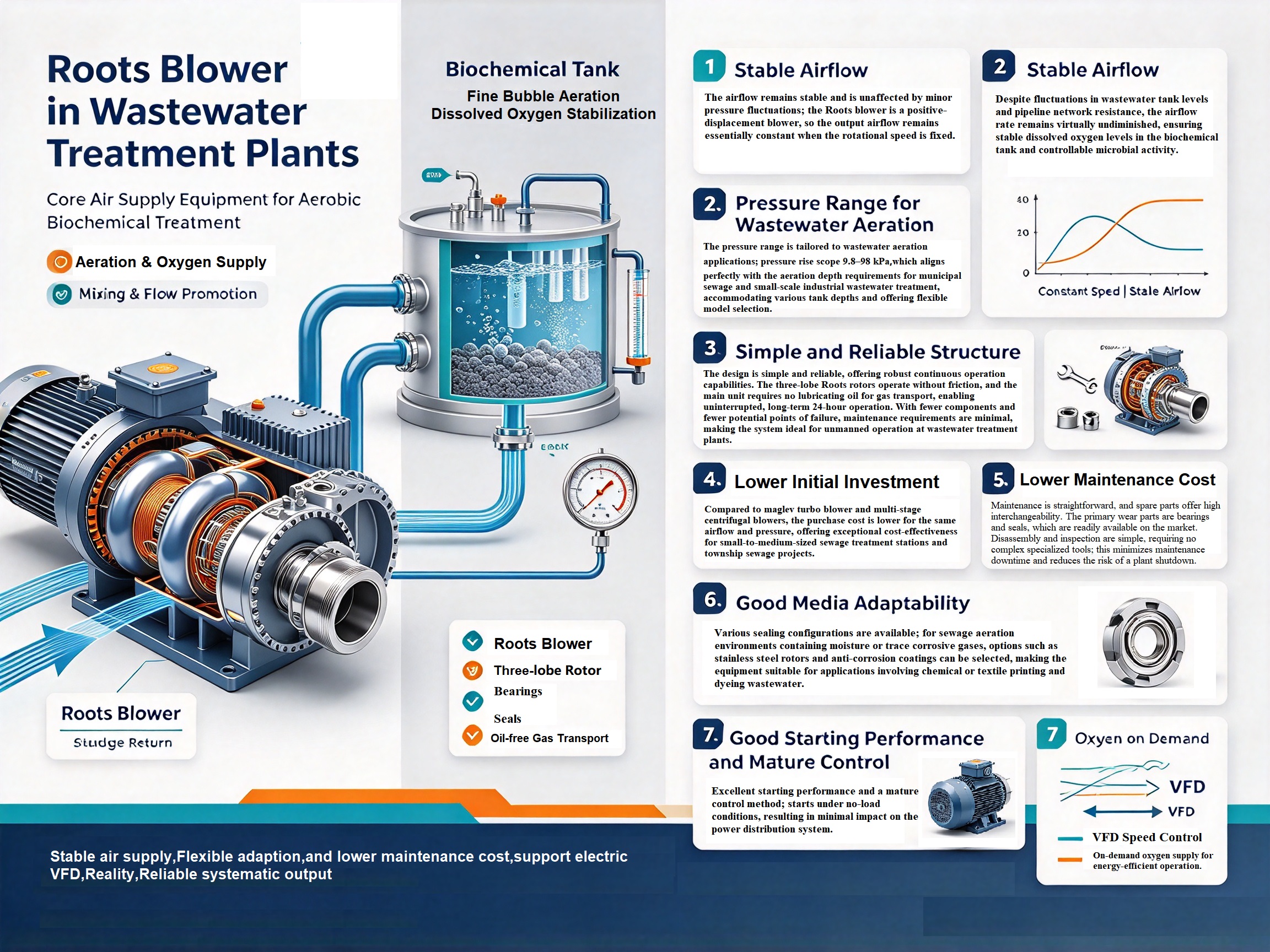
A Roots blower for wastewater treatment (three-lobe positive displacement blower) is the core air supply equipment for aerobic biochemical treatment in wastewater treatment plants. It is specially designed for biochemical tank aeration and sewage treatment working conditions, widely used in municipal sewage, rural sewage and small industrial wastewater treatment projects.
Different from centrifugal blowers and magnetic suspension blowers, the Roots blower adopts fixed rotor volume air supply logic, which can maintain stable air output under complex sewage working conditions. It undertakes three core working links in the biochemical treatment process:
1.1 Biochemical Tank Aeration and Oxygen Supply for Roots blower for wastewater treatment
The Roots blower continuously delivers stable air to the aerobic biochemical tank, maintaining reasonable dissolved oxygen content in the sewage, activating microbial flora, and accelerating the decomposition and degradation of organic pollutants in wastewater.
1.2 Sewage Mixing and Flow Pushing of Roots blower for wastewater treatment
The continuous air flow forms effective stirring thrust in the tank, prevents sludge sedimentation, keeps sewage and microbial agents fully mixed, and ensures the uniformity of biochemical treatment.
1.3 Sludge Reflux Support of Roots blower for wastewater treatment
It provides stable air power for sludge reflux systems, realizes the cyclic treatment of activated sludge, and improves the overall purification efficiency of the wastewater treatment system.
2.Core Advantages of Roots Blower for Wastewater Aeration
2.1 Stable Airflow, Resistant to Pressure and Resistance Fluctuations of Roots blower for wastewater treatment
As a typical positive displacement blower, the Roots blower features fixed air output at a constant rotating speed. In actual wastewater treatment scenarios, factors such as fluctuating biochemical tank liquid level and pipeline resistance changes will not cause obvious attenuation of blower airflow. This stable air supply ensures consistent dissolved oxygen in the biochemical tank, keeps microbial activity in a controllable state, and avoids treatment efficiency fluctuations caused by unstable oxygen supply.
2.2 9.8-98kPa Pressure Range Perfectly Matches Sewage Working Conditions of Roots blower for wastewater treatment
The conventional pressure rise range of wastewater Roots blowers is 9.8kPa to 98kPa, which fully covers the aeration depth requirements of most municipal sewage and small industrial wastewater treatment tanks. Whether it is shallow oxidation ditches or deep biochemical tanks, the Roots blower can achieve accurate air supply matching with flexible model selection, adapting to diverse pool body depth designs.
| Aeration Depth (submergence) | Typical Discharge Pressure |
|---|---|
| 3–4 m (shallow oxidation ditch) | 30–40 kPa |
| 5–6 m (conventional activated sludge) | 45–60 kPa |
| 7–9 m (deep tank / MBR) | 60–85 kPa |
2.3 Simple and Reliable Structure, Supporting 24/7 Continuous Operation of Roots blower for wastewater treatment
The three-lobe Roots rotor operates without friction inside the equipment, and no lubricating oil participates in the gas transmission process. This oil-free air supply structure avoids secondary pollution to sewage and meets the environmental protection standards of wastewater treatment. With a compact structure, few parts and low failure rate, the blower supports 24-hour uninterrupted long-term operation, with low operation and maintenance thresholds, fully adapting to the unattended operation mode of most sewage plants.
2.4 Simple Maintenance and Universal Spare Parts of Roots blower for wastewater treatment
The main vulnerable parts of the Roots blower are standard bearings and sealing parts, which are highly universal and easily purchased in the global market. The disassembly, assembly and maintenance process does not require professional precision tools and complex technical operations, effectively shortening maintenance downtime. It greatly reduces the risk of sewage plant shutdown and ensures the continuous and stable operation of the wastewater treatment system.
2.5 Low Initial Investment with High Cost Performance of Roots blower for wastewater treatment
Compared with magnetic suspension blowers and multi-stage centrifugal blowers, Roots blowers have lower procurement prices under the same airflow and pressure parameters. For small and medium-sized sewage treatment stations, township and rural sewage renovation projects, Roots aeration blowers have outstanding cost performance, which can effectively reduce the initial construction investment of sewage treatment projects.
2.6 Excellent Medium Adaptability for Complex Wastewater Scenarios
of Roots blower for wastewater treatment
Aiming at the humid and slightly corrosive gas environment of sewage aeration, Roots blowers support diversified sealing configurations. Optional stainless steel rotors and anti-corrosion coatings enable the equipment to adapt to complex working conditions such as chemical wastewater, printing and dyeing wastewater, solving the corrosion and aging problems of ordinary blowers in industrial sewage treatment scenarios.
3.7 Stable Start-Up Performance and Mature Energy-Saving Regulation
of Roots blower for wastewater treatment
The Roots blower adopts no-load start-up, which has minimal impact on the power distribution system and avoids circuit load impact and equipment failure caused by instantaneous start-up. Equipped with variable frequency speed regulation technology, it can adjust airflow in real time according to the actual oxygen demand of the biochemical tank, realize on-demand oxygen supply, and achieve significant energy-saving operation effects.
3. Roots Blower vs Centrifugal & Magnetic Suspension Blower
In the field of wastewater aeration, Roots blowers have irreplaceable application advantages compared with other mainstream blower types, especially suitable for small and medium-sized sewage projects:
-
Air stability: Roots blower airflow is not affected by pressure fluctuations; centrifugal blower airflow decays with increased resistance
-
Cost advantage: Lower initial investment and simpler daily maintenance than magnetic suspension blowers
-
Scenario adaptability: More flexible for multi-depth tank bodies and complex industrial sewage environments
-
Operation stability: No surge risk, suitable for long-term unattended operation of sewage plants
| Criterion | Three-Lobe Roots blower | Multistage Centrifugal blower | Magnetic Bearing Turbo Blower |
|---|---|---|---|
| Flow behavior | Constant volume vs pressure | Flow drops as pressure rises | Constant pressure curve, surge risk |
| Initial cost | Low | Medium | High |
| Specific energy (kWh/1000 m³) | Higher | Medium | Lowest |
| Pressure range | 9.8–98 kPaindustrialairblower.com | 30–100 kPa | 25–130 kPazhanermachinery.com |
| Best flow range | Up to ~166 m³/min | Medium–large | Large, >100 m³/min |
| Maintenance | Simple, universal parts | Moderate | Requires specialist service |
| Noise | Higher | Lower | Lowest |
| Best fit | Small/mid plants, rural, standby | Large stable-load plants | Very large, energy-critical plants |
4. Common Applications of Wastewater Treatment Roots Blower
Benefiting from its comprehensive performance advantages, Roots aeration blowers are widely used in multiple scenarios:
-
Municipal domestic sewage treatment plants
-
Township and rural decentralized sewage treatment stations
-
Chemical, printing and dyeing, food processing industrial wastewater treatment
-
Biochemical tank aeration, sludge treatment and aeration flushing of MBR membrane systems
5. Frequently Asked Questions
5.1 Why use Roots blowers for wastewater aeration?
Roots blowers provide stable constant airflow, adapt to the pressure fluctuation of sewage tanks, support 24/7 oil-free operation, and have low operation and maintenance costs. They are the most cost-effective core aeration equipment for small and medium-sized wastewater treatment projects.
5.2 What is the working pressure range of a wastewater Roots blower?
The standard working pressure range is 9.8kPa to 98kPa, covering all conventional municipal and industrial sewage aeration depth requirements.
5.3 Is the Roots blower suitable for long-term unattended operation?
Yes. The friction-free rotor structure has few failure points, with stable continuous operation capability and low maintenance frequency, fully adapting to unattended working modes of sewage plants.
6. Conclusion
As the core aerobic treatment equipment for wastewater treatment, the Roots blower for wastewater aeration has become the preferred aeration solution for global small and medium-sized sewage projects by virtue of stable air supply performance, wide pressure adaptation range, reliable continuous operation, low maintenance cost and strong scene adaptability. Equipped with frequency conversion energy-saving configuration, it can further reduce the operating energy consumption of sewage plants, bringing dual economic and environmental benefits for sewage treatment engineering construction and operation.