1. Why Roots Blowers Vacuum Pump Show Up in Lithium Anode Plants
In a lithium-ion battery, the anode (mostly synthetic/natural graphite, increasingly Si-carbon composite) decides cycle life and fast-charge ability. Before the powder ever reaches a coating line, it must survive crushing, screening, calcining, and classifier loops — all of which move fine, abrasive, flammable dust.
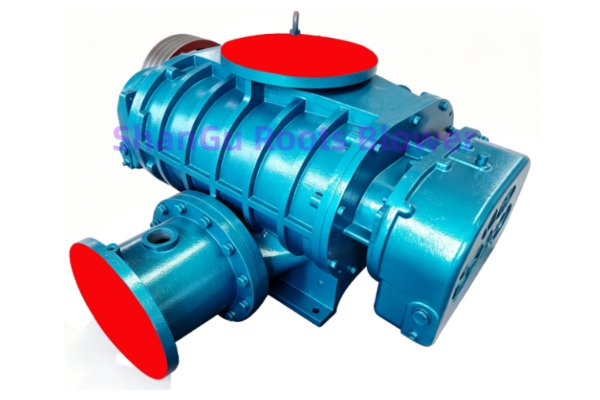
That’s where the roots blower vacuum pump(rotary lobe / positive displacement blower) earns its spot: it generates steady, pulse-resistant airflow that pushes or pulls powder through closed piping.
2. What the Conveying Loop Actually Looks Like if roots blower vacuum pump available
Below is the typical anode powder pressure-conveying section where a Roots blower vacuum pump lives. (Your plant may add a negative-pressure suckat the mill outlet and a positive-pressure push into the surge hopper — many lines run both.)
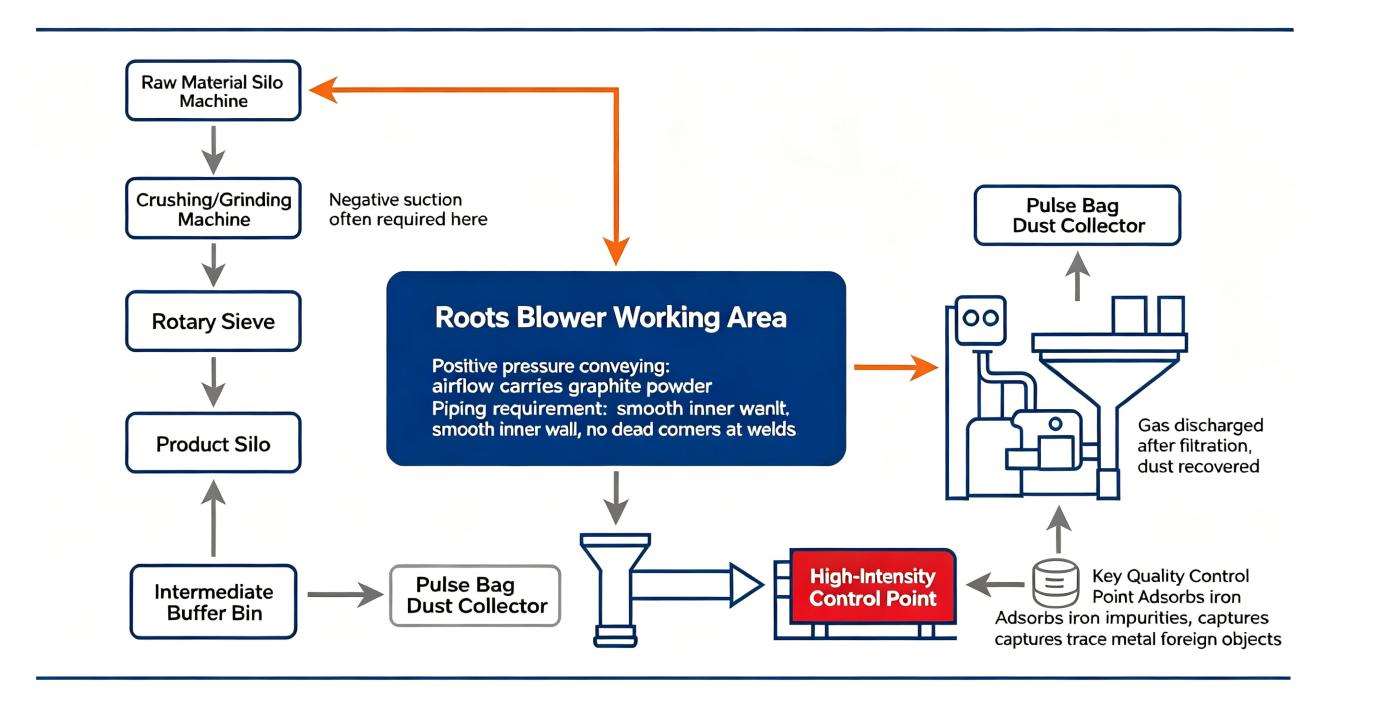
Where the Roots blower vacuum pump sits: after the rotary valve / feeding point, supplying low-pressure bulk air (typically 0.2–1.0 barG for dense-phase anode lines). Stainless lobe, oil-free clearance, driven by belt or direct-coupled motor.
3. Five Reasons Anode Plants Prefer Roots Blower vacuum pump Instead of Mechanical Conveyors
| # | Advantage | Why it matters to an anode line |
|---|---|---|
| 1 | Closed piping = dust-free workshop | Graphite dust is conductive & explosive (St1–St2). Closed loop + baghouse beats screw/spillage hands-down. |
| 2 | Less product loss → higher effective yield | What doesn’t leak is what you sell. Downtime for clean-up drops sharply. |
| 3 | Labor substitution | One operator monitors SCADA; no pit shoveling. Labor cost + scarcity is a real pain in CN/KR/JP plants. |
| 4 | Throughput stability | PD blower holds flow even when back-pressure swings — unlike centrifugal, which slides on its curve. |
| 5 | Quality repeatability | No manual batch dumping → less human variance in bulk density & tap density of the outgoing powder. |
4. The “Cu/Zn-Free” Rule for roots blower vacuum pump– The Real Differentiator
This is the part overseas buyers care about most, and where a generic industrial Roots blower fails a锂电 anode spec.
Why copper & zinc are banned
Anode material incoming inspection typically demands:
Total Fe ≤ 30–50 ppm (top-tier customers push ≤ 10 ppm)
Cu, Zn, Ni → “not detected” or ≤ 1–5 ppm
If a Cu or Zn particle hides in the graphite and reaches cell assembly:
It acts as a local current collector → lithium plates unevenly → dendrite grows.
Dendrite punctures separator → internal short → thermal runaway.
One batch rejected = entire campaign scrapped. So roots blower itself must not shed metal.
How a “Li-anode grade” Roots blower vacuum pump is built differently
| Component | Standard PD blower | Anode-grade (Cu/Zn-free) |
|---|---|---|
| Lobes / casing | Grey iron / carbon steel | 316L stainless or ceramic/PU coating |
| Fasteners | Galvanized (Zn!) bolts | All stainless, zero Zn |
| Paint | Zn-rich primer (common!) | Zn-free, Cu-free epoxy / polyurethane, or passivated bare metal |
| Nameplate | Brass / aluminum | Stainless etched plate |
| Shaft seals | Standard rubber + steel spring | PTFE + SS spring; oil mist must stay out of process air |
| Bearing cage | Often brass | Polyamide / stainless keeper |
5. Roots Blower vacuum pump vs. Screw vs. Centrifugal – Quick Buyer Cheat Sheet
| Roots (PD) blower vacuum pump | Oil-free screw | Centrifugal | |
|---|---|---|---|
| Pressure range | 0.2–1.0 barG (dense-phase anode) | Up to 3–4 barG | <0.5 barG |
| Flow stability | Constant, pressure-independent | Constant | Drops on back-pressure |
| Noise | Higher (whisper kits available) | Medium | Lowest |
| Oil-in-air risk | Zero (if non-lubricated seal) | Zero (oil-free screw) | Zero |
| CapEx | Low–Mid | High | Mid |
| Anode fit | Front-end crush/screen convey | Clean-end / N₂ loop | Rare – only big dilute-phase lines |
Rule of thumb EPCs use: Roots for the “rough” legs (post-mill, pre-calcine); oil-free screw or claw for the clean / N₂ legs (finished powder → packing).
6. Explosion Protection & N₂ Loop (don’t skip)
Anode powder lines are almost always ATEX / IECEx Zone 21–22 inside piping.
- Roots Blower Vacuum Pump: II 2D / II 3D rated, flame-path joints, anti-static lobes.
- Piping: grounded, SS304/316L, smooth weld.
- Dust collector: PTFE membrane bags, explosion vent / isolation flap upstream.
- Inerting: N₂ blanket on finished-powder leg; O₂ < 8% if you’re paranoid (good plants are).
If you’re bidding into Korea, Japan, or EU cathode/anode JV lines, ATEX dossier + Declaration of Conformity moves the needle more than price.
7. FAQ
Q: Can I use a standard cast-iron Roots blower for anode graphite?
A: Technically it moves the powder, but you’ll fail the Cu/Zn/Fe spec. Cast housings shed, galvanized bolts leach Zn, standard paint flakes. One bad batch costs more than the blower. Use anode-grade stainless build.
Q: Oil-free or oil-lubricated?
A: Oil-free (non-lubricated timing gears, PTFE seals) is strongly preferred on the process-air side. Even a mist of gear oil can contaminate high-purity anode powder.
Q: What flow/pressure do anode lines typically need?
A: Dense-phase graphite: 6–15 m³/min per blower, 0.3–0.8 barG is common. Final selection rides on pipe layout, conveying distance, and solids loading ratio — send your P&ID and we size it.
Q: Do I need a spare?
A: Most Tier-1 anode plants run 1-working + 1-standby per critical leg. Downtime cost >> blower cost.
8. Required Information in RFQ
If you want real quotes instead of catalog spam, send suppliers this:
- Powder: graphite / Si-C blend? Mean particle size (D50)? Abrasive rating?
- Throughput: t/h per line, number of lines.
- Conveying mode: dilute vs. dense phase, distance, elevations.
- Gas: plant air vs. N₂ closed-loop.
- Mandatory: Cu/Zn-free declaration + material certs + paint MSDS.
- Explosion rating: ATEX zone, St class, Kst if known.
- Preference: bare shaft / package (silencer, VFD, local panel)?
A Roots blower on an anode line isn’t a commodity blower — it’s a contamination gatekeeper. Pay for the stainless/Cu-Zn-free build once, or pay for rejected batches forever.